
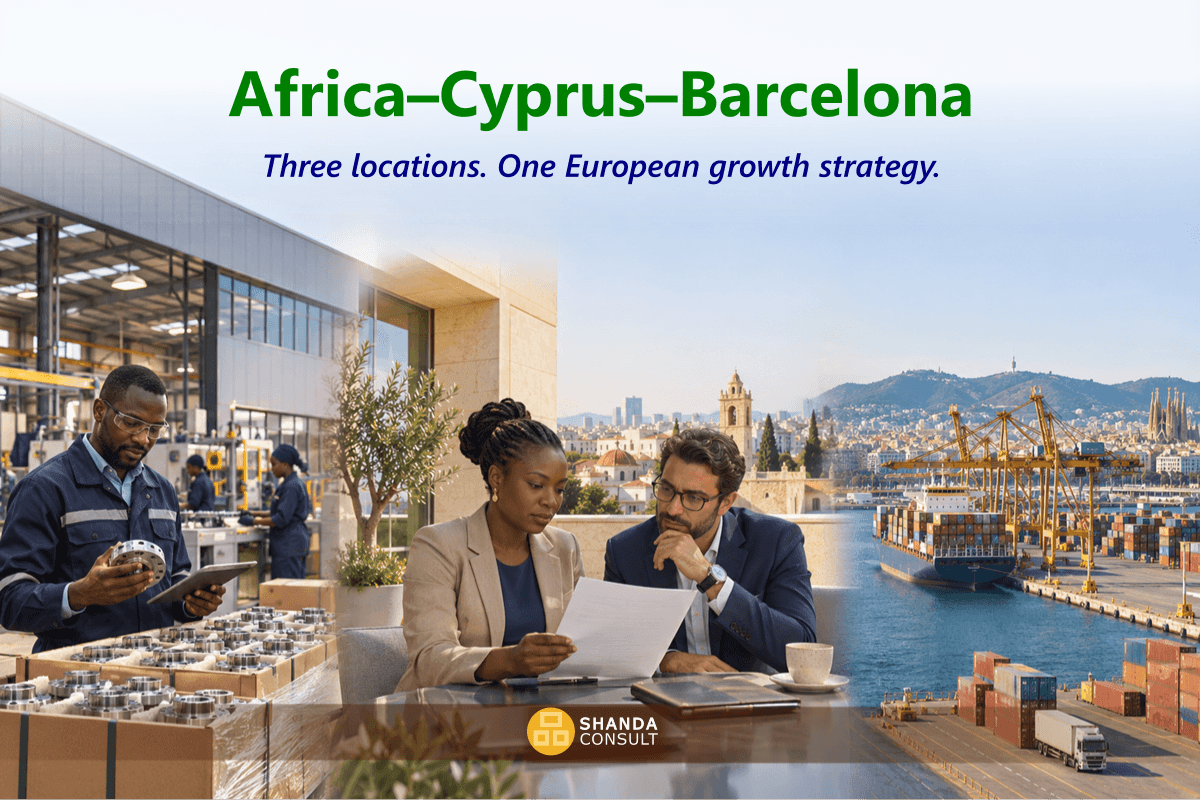
Africa–Cyprus–Barcelona: A Practical Model for African Exporters Entering Europe
Drafted: 4 November 2026 | by Stefan Nolte
African production. Cyprus commercial management. Barcelona logistics and customer support. A carefully designed division of responsibilities can help African businesses build a European presence while managing their overall tax burden.
An African manufacturer can produce an excellent product and still face considerable obstacles when expanding into Europe. Buyers want dependable delivery, clear contractual responsibility and someone who can respond when a shipment is delayed or a product needs attention. The exporter needs working capital, reliable payment arrangements and a structure that can grow beyond its first European customer.
Choosing where to incorporate is only one part of that decision. A more useful question is where each part of the European business should take place.
For some established African exporters, the answer could combine three locations: production in Africa, European commercial management in Cyprus, and logistics and customer support in Barcelona.
Our collaborator ProdAfrica recently explored the broader concept in its article, “Cross-Border Corporate Architecture: How African Companies Entering the EU Can Use the Cyprus-Barcelona Dual-Hub Model”. The approach below develops one particular version for businesses exporting goods: a substantive Cyprus company acting as the European principal, supported by a Barcelona subsidiary with defined logistics and service responsibilities.
The attraction is both commercial and financial. European customers gain access to stock and support on the mainland. The group gains a European management and investment platform. Where the actual division of work supports it, profits can also be taxed more efficiently.
For a broader overview of Cyprus as a European base for African businesses, see our guide to the commercial and practical advantages of establishing a presence on the island.
Three locations with distinct responsibilities
The African company retains its production business, workforce and supplier relationships. It supplies products to the Cyprus company at an arm’s-length price that rewards its manufacturing activities, assets, expertise and risks.
The Cyprus company purchases the goods, manages the European commercial business and sells to European customers. Its responsibilities can include customer contracts, pricing, procurement planning, working capital and control of inventory and customer credit risks. It may also own the Spanish subsidiary and manage investment in further European markets.
The Barcelona subsidiary provides services: receiving and storing goods, arranging fulfilment and delivery, handling returns, and providing defined after-sales support. It receives an arm’s-length fee from Cyprus for doing so.
Goods can travel directly from Africa to Spain. Their contractual ownership and the location of commercial management do not require them to pass physically through Cyprus.
.
| Function | African company | Cyprus principal and holding company | Barcelona service subsidiary |
| Manufacturing, production quality and African workforce . | Responsible | Coordinates purchasing requirements | — |
| Supply of finished products . | Sells on arm’s-length terms | Purchases for European business | Receives goods physically |
| European commercial strategy and pricing . | Provides product and production input | Responsible | Provides factual market feedback |
| Customer contracts and sales invoicing . | — | Responsible | Administrative assistance only |
| European working capital and control of trading risks . | Retains risks appropriate to its supply role | Responsible for principal’s risks | Bears risks appropriate to its services |
| Warehousing, fulfilment and delivery . | — | Commissions and supervises services | Performs services |
| Routine returns and after-sales support . | Supports manufacturing defects as agreed | Sets commercial policy and bears agreed exposure | Performs defined support tasks |
| European subsidiary ownership and expansion investment . | Funds expansion where appropriate | Holds and manages investments | Operates its local service business |
| Basis of profit | Appropriate production and supply profit . | Profit attributable to its commercial functions and risks | Appropriate service profit |
This is a proposed operating model, rather than a mandatory template. Product regulation, customer expectations and the group’s existing capabilities may require changes.
Physical distribution is different from a resale business
The word “distribution” can describe two very different activities.
A logistics service provider stores someone else’s goods and delivers them under instructions. A commercial distributor buys goods and resells them to its own customers. The latter may perform sales functions and assume substantially greater commercial responsibilities.
The model discussed here uses Barcelona primarily for physical distribution and support. Customer contracts are with Cyprus. The Spanish subsidiary does not independently set sales prices or operate as the principal European seller.
This distinction affects remuneration. A business providing defined services can often be remunerated by reference to its relevant costs and an appropriate profit margin. A buy-and-resell business requires analysis appropriate to its distribution functions. The method and return must follow the facts and comparable independent arrangements, rather than a preferred tax outcome.[1]
Customer contact is still possible. Spanish staff could communicate delivery dates, arrange visits to inspect products or stock, and process support requests within agreed limits. Where their work develops into substantive sales negotiation or management of key commercial relationships, the allocation of profit and permanent-establishment position need reviewing.
Why Cyprus must be an operating principal
A company earning the principal European trading profit needs the capacity to conduct that business.
For Cyprus, that means decision-makers with relevant experience and real authority. They must have access to information, oversee the business and control the risks for which the company is remunerated. The company also needs appropriate capital and the financial capacity to bear those risks.
An office and local directors can support that position. Their presence alone does not establish it. The key question is who actually decides which customers to accept, what commercial terms to offer, how much inventory to finance and what to do when customers fail to pay.
Some tasks can be outsourced, but the principal must retain the relevant control and oversight. Contracts, internal approvals and everyday behaviour should tell the same story.[1]
That requirement applies on both sides of the structure. If the African management team continues to make all European commercial decisions, substantial profit cannot simply be attributed to Cyprus through invoicing. Equally, the African manufacturer must receive proper compensation for its own contribution, including valuable know-how or product intangibles where relevant.
For an exporter willing to establish a real European management function in Cyprus, these requirements can support the business it wants to build: a team responsible for serving and developing its European market.
Comparing the economics
Spain’s standard corporate income tax rate is 25%. Cyprus’s standard corporate income tax rate is 15% from 1 January 2026.[2][3] Spain has reduced rates for qualifying businesses, but the comparison below uses the standard rates and is aimed at an established exporter.
Assume that, after paying an appropriate price to the African manufacturer and meeting European operating costs, the European business produces €1 million of annual profit before corporate tax and before any additional cost of a Cyprus principal.
In the first model, a Spanish company conducts the European trading business itself. In the second, the group establishes a genuine Cyprus principal, while Spain provides logistics and support.
For the second model, assume Spanish service costs of €500,000 and an illustrative 8% markup, producing a €540,000 service fee and €40,000 Spanish profit. Also assume €120,000 of additional annual Cyprus operating costs beyond costs already included in the first model.
.
| Annual calculation | European trading business in Spain | Cyprus principal with Barcelona services . |
| European profit before tax and additional Cyprus costs . | €1,000,000 | €1,000,000 |
| – Additional annual Cyprus operating costs . | — | – €120,000 |
| Combined taxable profit after those costs . | €1,000,000 | €880,000 |
| Profit taxable in Spain . | €1,000,000 | €40,000 |
| Profit taxable in Cyprus . | — | €840,000 |
| – Spanish corporate tax at 25% . | – €250,000 | – €10,000 |
| Cyprus corporate tax at 15% . | — | – €126,000 |
| – Combined European corporate tax . | – €250,000 | – €136,000 |
| European profit remaining after operating costs and corporate tax . | €750,000 | €744,000 |
Although corporate tax is €114,000 lower, the additional €120,000 operating cost leaves the group €6,000 worse off in this example. At this scale and with these assumptions, tax savings alone would not justify the structure.
Scale changes the result. If the starting European profit were €2 million, with the same additional Cyprus costs and Spanish service profit, the first model would leave €1.5 million after tax. The second would leave €1.594 million: a €94,000 annual improvement.
Actual costs and service remuneration may increase as the business grows. The 8% markup is an arithmetic assumption, not a benchmark or safe harbour. The €120,000 cost allowance is also illustrative, rather than a quotation or an estimate of the substance required for a particular business.
These comparisons hold the African manufacturer’s remuneration constant. They exclude shareholder-level taxes, dividend withholding, CFC inclusions, financing effects, setup costs and any differences in customs or VAT costs. Those items must be added before calculating the group’s overall result.
The example shows why a structure should be assessed through a complete business forecast. For one company, the principal benefit may be commercial resilience and future expansion. For another, sufficiently large profits may also produce meaningful net tax savings.
Can notional interest deduction improve the Cyprus result?
An exporter financing inventories and customer payment terms may need substantial equity. Cyprus’s notional interest deduction, or NID, can therefore deserve particular attention.
Qualifying new paid-up share capital or share premium used to generate taxable income can support an annual deduction. The applicable reference rate is linked to the relevant country’s ten-year government bond yield plus five percentage points. The deduction is capped at 80% of the taxable profit attributable to assets financed by that equity.[4]
For this model, the analysis would trace eligible equity into the Cyprus principal’s income-producing business, potentially including trading working capital. It would examine the use of funds, applicable reference rate and anti-abuse rules.
An equity injection does not automatically produce the maximum deduction. Nor does equity used simply to hold a Spanish subsidiary generating exempt dividends create the same opportunity as equity financing taxable trading activities.
The comparison above deliberately includes no NID benefit. A separate calculation can show what is available on the business’s actual funding arrangements and whether the African home country recognises or counteracts the resulting tax position.
Dividends from Spain to Cyprus
The Spanish subsidiary’s service profit may eventually be distributed to its Cyprus parent.
Spanish domestic rules implementing the EU Parent–Subsidiary framework can exempt qualifying dividends. Published conditions include a minimum 5% participation and a one-year holding period, which can be completed subsequently. Spain also has a specific anti-abuse provision relevant to EU parents ultimately owned outside the EU or qualifying EEA states, with an exception based on valid economic and substantive business reasons.[5]
The Cyprus–Spain tax treaty provides a separate route. Article 10 exempts dividends paid to a qualifying resident corporate recipient directly holding at least 10% of the payer’s capital; otherwise, it provides a 5% ceiling where its conditions are met.[6]
Treaty entitlement must also satisfy applicable anti-abuse requirements, including the MLI principal-purpose test. An African-owned Cyprus company is not automatically disqualified, but its commercial role and entitlement require assessment.[7]
On the ordinary facts contemplated here, dividends from the active, normally taxed Spanish subsidiary should be exempt from Cyprus corporate income tax and SDC. This treatment preserves the subsidiary’s post-tax profit for the group; it does not remove the Spanish tax already paid.
What happens when profits reach African owners?
The final tax result depends on who owns Cyprus and where those owners are tax resident.
One structure places the Cyprus company below the existing African operating company. Another has the founders own Cyprus directly alongside their African business. These arrangements can produce different outcomes and should be compared before incorporation.
Personal ownership is not automatically preferable. An existing African company may already own customer relationships, contractual opportunities or valuable rights. Moving those assets or opportunities to another company can itself require compensation and create tax consequences.
For each proposed ownership arrangement, four questions are particularly important.
How are dividends taxed? A corporate shareholder may qualify for a foreign-dividend participation exemption. An individual may face a different rate or exemption. Minimum ownership percentages, share rights and other conditions may matter.
Can retained profits be taxed before distribution? Controlled foreign company rules can attribute foreign-company income to resident owners even when no dividend is paid. The rules may distinguish active trading income, financing income and dividends received from subsidiaries. Retaining cash in Cyprus does not necessarily defer African taxation.
Does the home country apply a low-tax or minimum-tax adjustment? A deduction reducing Cyprus tax can affect the African result. The relevant test may examine effective tax, the character of income, related-party transactions or a combination of factors.
What relief is available for foreign tax? Tax paid by the Spanish subsidiary, tax paid by Cyprus and withholding deducted from a distribution are different layers. The African shareholder may not receive a credit for all of them. An exemption and a credit can also produce very different outcomes.
Cyprus generally pays dividends to non-residents without withholding, subject to targeted exceptions, including provisions concerning certain corporate recipients in EU tax-blacklisted or low-tax jurisdictions. Current recipient status must be checked. The EU tax blacklist is separate from its AML high-risk list; an AML listing can complicate banking without itself establishing the tax-blacklist withholding treatment.[4][8][9]
These questions require a country-specific calculation for both annual distributions and retained profits. There is no single African tax outcome.
Spanish permanent establishment, VAT and customs
The Spanish subsidiary’s own corporate tax is only one part of the Spanish analysis.
A separate question is whether the Cyprus principal has a taxable permanent establishment in Spain. Relevant facts include the use and availability of premises and what Spanish personnel actually do for Cyprus. The treaty states that subsidiary ownership alone does not create a permanent establishment, but the complete operating arrangements still require review.[6]
A Spanish VAT registration may also be necessary even where the Cyprus company has no Spanish corporate-tax PE. VAT registration, a VAT fixed establishment and an income-tax permanent establishment are separate concepts. Stocks in Spain and subsequent sales must be mapped by transaction, customer and destination.
The business should decide who imports the goods, who owns them at each stage and who holds the customs and VAT records supporting any import-VAT recovery. Delivery terms and contractual responsibilities must be consistent with those decisions.
Customs valuation needs separate attention when the manufacturer and buyer are related. A related-party price is not automatically rejected, but its acceptability for customs purposes must be established. Import VAT is generally based on customs value with specified additions.[10][11]
Cyprus ownership does not change a product’s customs origin. Any preferential tariff treatment depends on the applicable trade arrangements, origin rules and evidence. Product-specific requirements—such as food controls, labelling, safety or conformity obligations—also need allocating to the appropriate entities.
Banking and implementation must follow the business
An EU company does not remove the need to explain African ownership and source of funds to banks. A clear structure can help present the business coherently, but onboarding still depends on the countries, products, counterparties and transaction patterns involved.
The group should be able to explain why Cyprus manages the commercial business, why Barcelona handles goods and support, how prices are determined and how money moves between the companies.
Implementation should begin with the operating model and financial forecast. Those establish the staffing, capital, premises and service requirements. The legal agreements, transfer-pricing policy, registrations and banking arrangements then need to reflect the same model.
Where an existing European business is being reorganised, transferring functions, assets, customer relationships or risks can have tax consequences of its own. The analysis differs from establishing a new business on these terms from the outset.
Our Africa–Cyprus Business Gateway Blueprint provides further guidance on preparing an African business for European expansion through Cyprus.
Which exporters should consider the model?
The structure is most relevant where continental stock and support materially improve customer service, European sales are substantial or growing, and the group has a genuine reason to establish commercial management in Cyprus.
Examples could include manufacturers of specialised components, processed agricultural products, packaged goods or industrial equipment. Suitability depends on the product, margins, regulation and the services customers need.
A small exporter testing its first orders might be better served initially by an independent logistics provider, agent or distributor. A group whose entire European commercial management needs to be in Spain may have little reason to establish a Cyprus principal.
For very large groups, Pillar Two is an additional consideration. Groups meeting the €750 million consolidated-revenue threshold and the other conditions need to model minimum-tax rules and possible top-up taxation separately.[12]
Building a European business around complementary strengths – including the Cyprus Non-Dom Status
Africa, Cyprus and Barcelona can each contribute something different: production capacity and expertise, European commercial management and investment coordination, and a mainland base for goods and customer support.
The financial benefit depends on matching those responsibilities with actual capabilities and an appropriate allocation of profit. It also depends on the cost of operating the structure and the tax rules where the African owners are resident.
For an individual African shareholder willing to relocate, Cyprus can offer an additional personal tax advantage. A genuine move, establishing Cyprus tax residence and qualifying for non-dom treatment, can allow dividends from the Cyprus company to be received free of Cyprus personal income tax and Special Defence Contribution. General Healthcare System (GHS) contributions may nevertheless apply, subject to the applicable rules and annual contribution ceiling. Tax residence and non-dom eligibility are separate requirements; a residence permit alone establishes neither. See the Cyprus Tax Department’s guidance on tax residence and domicile.
Relocation can also bring the shareholder closer to European customers and allow an experienced owner-manager to lead the Cyprus commercial operation personally, strengthening its business capabilities and substance. For suitable founders, the combined business and personal benefits could materially improve the overall proposition.
The home-country consequences must be reviewed before moving, including cessation of personal tax residence, any exit taxes, continuing source-country taxation and the treatment of subsequent dividends. If the Cyprus company remains owned by an African corporate parent, the founder’s personal relocation does not remove that parent’s tax obligations. Any ownership restructuring requires separate assessment. Immigration permission and the right to work in Cyprus must also be addressed where the shareholder will manage the business locally.
For an established exporter planning its next stage of European growth, that combination deserves a structured feasibility assessment.
Planning to expand an African manufacturing or export business into Europe?
Contact Shanda Consult to assess whether a Cyprus European principal, supported by a Barcelona logistics and service operation, fits your business, ownership and growth plans.
This article provides general information based on the framework reviewed in November 2026. Implementation requires coordinated advice for the African home jurisdiction, Cyprus and Spain.
Sources and further reading
Starting point: ProdAfrica — Cyprus–Barcelona dual-hub model.
- OECD Transfer Pricing Guidelines 2022, particularly functional analysis, risk control and method selection.
- Spanish Tax Agency — Corporate income tax rates.
- Cyprus Ministry of Finance — Stability Programme, April 2026, corporate tax reform.
- Cyprus Ministry of Finance — Tax incentives.
- Spanish Government — Taxation of parent companies and subsidiaries.
- Cyprus–Spain tax treaty — Official Spanish publication, Articles 5, 7, 9 and 10.
- Spanish Ministry of Finance — Synthesised treaty text incorporating the MLI.
- Council of the EU — List of non-cooperative jurisdictions for tax purposes.
- European Commission — AML/CFT high-risk third countries.
- European Commission — Customs valuation guidance.
- European Commission — VAT taxable amount, including imports.
- European Commission — Minimum corporate taxation.